
Invasive Species
Introduction | Species Info | Teacher Materials | Resources
Species Information: Hydrilla
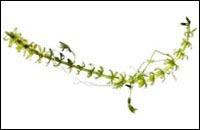 Although this submerged invasive plant has a common name associated with its physical similarity to a well-known spice, it is better known by its scientific name, hydrilla, because of its tendency to endanger like the many-headed serpent in Greek mythology, Hydra, which grew two appendages in each place where one was cut off.
A native plant in parts of Asia, Africa and Australia, hydrilla was probably brought into the U.S. in the 1950s by the aquarium trade. It is a popular aquarium plant, along with two other submerged plants, Eurasian watermilfoil and Brazilian elodea. One must look carefully at each plant to determine the differences among these three invasive species. Hydrilla is a submerged perennial forming dense stands of very long stems in the water. Leaves are small, pointed and arranged in whorls of 4 to 8 along the stem, and leaf margins are saw-toothed. (Watermilfoil’s leaves are in whorls of 4-5, and elodea, whorls of three.) A stem feels rough when pulled through the hand. Seasonally, it has tiny white flowers. It is a freshwater plant that grows rooted to the bottom in still or flowing water, but it can tolerate up to 7 percent salinity.
Like the mythical Hydra, hydrilla reproduces by regrowth of stem fragments but it can also reproduce by axilliary (like a feather) buds and subterranean tubers that can remain dormant but alive for up to four years. A single tuber can produce more than 6,000 new tubers per square meter of water area.